
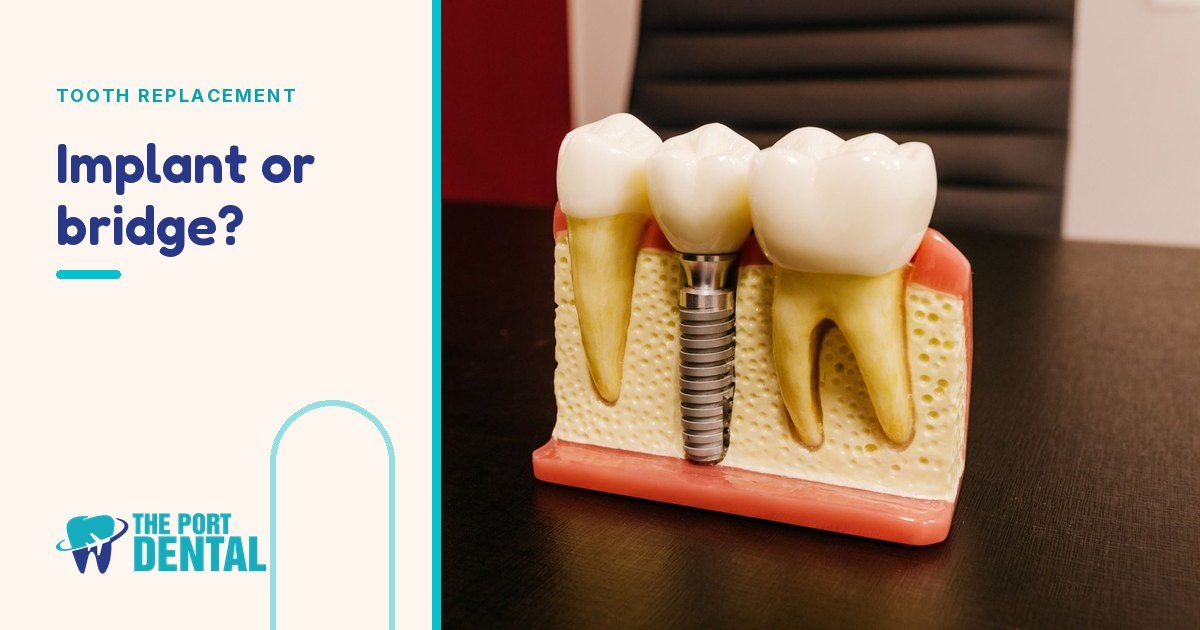
The main implant vs bridge difference is support. A single tooth implant replaces the missing tooth’s root with a titanium post in the jawbone, so the teeth beside the gap are left alone. A bridge fills the gap with a false tooth held by crowns on the two neighbouring teeth, which must be filed down. A bridge is usually done in a few visits, while an implant needs several months to heal. The Canadian Dental Association says a well-cared-for bridge should last about 10 years or longer. The CDCP covers neither. Your neighbouring teeth, jawbone, health and budget decide which option suits you.
At The Port Dental Clinic in NE Calgary, our dentists explain both options after an exam and X-rays. Read more about dental implants and dental bridges at our clinic.
What is the difference between an implant and a bridge?
A dental implant is an artificial root made of titanium that is placed in the jawbone. Once it heals, an abutment (a small connector) and a crown (the visible tooth) are attached. The implant stands on its own.
A bridge is an artificial tooth fused between 2 crowns. The false tooth is called a pontic. The crowns fit over the teeth on each side of the gap, called abutment teeth, which the dentist files down first. A bridge is cemented in place, so you cannot remove it.
Other bridge designs exist. A resin-bonded (Maryland) bridge uses metal bands cemented to the back of nearby front teeth. A cantilever bridge is anchored on one side only. This guide compares the most common choice, a traditional bridge, with a single implant.
Implant vs bridge: side-by-side comparison
Here is how the two options compare for one missing tooth:
| Single tooth implant | Traditional bridge | |
|---|---|---|
| How it works | A titanium post in the jaw holds a crown | A false tooth sits between crowns on the neighbouring teeth |
| Neighbouring teeth | Not used for support | Filed down to hold crowns |
| Procedure | Surgery under local anaesthetic (freezing), then a crown | Teeth shaped, impressions taken, temporary bridge, then final bridge |
| Time to finish | Several months of healing before the final crown | A few visits, with a temporary bridge in between |
| Daily cleaning | Brush and floss like a natural tooth, gently at the gumline | Brush, and floss under the false tooth with a floss threader |
| Typical lifespan | The CDA gives no set figure. It calls an implant a one-time cost in most cases. The crown on top can wear, and crowns can last 10 years or longer. | About 10 years, or perhaps longer, with good care |
| Cost drivers | Imaging, any extraction or bone graft, abutment, crown and lab fees | Number of teeth spanned, materials, lab fees and any work on the supporting teeth |
| CDCP coverage | Not covered | Not covered |
When might an implant suit you?
- The teeth beside the gap are healthy, with few or no fillings, and you would rather not file them down.
- You are in good general health, with healthy gums and enough jawbone. The CDA lists these as the main requirements.
- You can wait several months for healing before the final crown.
- You are comfortable with a surgical step and with careful cleaning around the implant every day.
Your dentist will also review your health history, including smoking, diabetes and bone medicines, before recommending surgery. They will explain who places the implant, here or with a specialist, before treatment starts.
When might a bridge suit you?
- The neighbouring teeth already have large fillings or crowns, so covering them with new crowns may help them too.
- There is not enough bone for an implant, and you would rather avoid a bone graft.
- Your health or medicines make surgery less suitable.
- You want the gap filled sooner, without months of healing.
A removable partial denture is a third option. It is held in place by clasps that fit onto nearby healthy teeth, and you take it out to clean it.
How much does an implant cost compared with a bridge?
Fees vary with each case, so the only reliable number is a written estimate after an exam. The CDA notes that implants can cost more than other kinds of replacement teeth and might not be covered by your plan. It adds that in most cases an implant is a one-time cost. A bridge may need replacing at some point, so it helps to compare costs over many years as well as upfront. These factors move the price of either option:
- Extractions, bone grafts or gum treatment needed first
- 3D imaging and planning for an implant
- The number of teeth the bridge spans
- Materials and dental lab fees
- Root canal or build-up work on the supporting teeth
- Whether part of the care is done by a specialist
For implant pricing in detail, read dental implants cost in Calgary and factors that affect implant cost.
Insurance varies by plan. Before treatment, you can ask your insurer for a predetermination, a written estimate of what your plan will pay. We can help with the paperwork. The CDCP Dental Benefits Guide lists implants, bridges and all related procedures as exclusions. Alberta’s Dental Assistance for Seniors program does not cover crowns, bridges or implants either. Financing is available through LendCare.
How do you care for an implant or a bridge?
Both need daily brushing, daily flossing and regular checkups. For a bridge, the CDA recommends a floss threader to clean under and around the false tooth. Keep the supporting teeth healthy, since the bridge depends on them.
For an implant, brush all sides of the implant gently and floss at least once a day, with extra care where it meets the gum. With any crown, the CDA advises avoiding hard objects like ice or pens. Our list of foods to avoid with a dental bridge has more everyday tips.
When to call us
Call us or book a visit if:
- You have lost a tooth and want to talk about replacing it
- A bridge or implant crown feels loose, or your bite feels different
- You notice pain, swelling or a bad taste around a supporting tooth or implant
- The gum around an implant bleeds or looks red and puffy
- A crown, bridge or temporary breaks or comes off
We offer same-day emergency appointments when possible. Outside our hours, call Health Link 811 for 24/7 advice on your symptoms and care options. Call 911 for trouble breathing or swallowing. Go to the nearest emergency department for facial swelling, fever or a facial injury.
Questions about implants and bridges
The CDA says a well-cared-for bridge should generally last about 10 years or longer. It gives no set lifespan for implants but describes them as a one-time cost in most cases. The crown on an implant can still wear over time.
Yes. A traditional bridge needs the neighbouring teeth filed down so crowns can fit over them, and that change is permanent. An implant does not use the neighbouring teeth for support.
A bridge usually takes a few visits. An implant needs several months to heal before the final crown goes on, and longer if a bone graft is needed.
No. The CDCP Dental Benefits Guide lists implants, bridges and all related procedures as exclusions. Private plans vary, so ask your insurer for a predetermination before treatment.
To compare both options for your own mouth, learn about dental implants and dental bridges at The Port Dental Clinic. Book online or call 403-345-1110. We are at 4250 109 Ave NE #3145 in NE Calgary, open seven days a week, with direct billing and LendCare financing.